
WELCOME BONUS 300%
UP TO €2000 + 100
FREE SPINS
UP TO €2000 + 100
FREE SPINS
Home → Blackjack
Blackjack at Mystake Casino: Variants, Rules and Payouts
Soft Hand and Hard Hand Practically Distinguished
Blackjack Split / Double / H17 demonstrates that Dealer Hits Soft 17 increases the house edge by exactly 0.22 percentage points compared to standing rules. This specific rule modifier significantly impacts the theoretical return, requiring players to adjust their basic strategy for optimal decision-making on every hand dealt during a session. The adjustment affects long-term profitability more than minor variations in deck composition or surrender options available at other tables.
Resplit Aces improves the Return to Player by 0.08 percentage points, while Double After Split adds another 0.14 percentage points to the player advantage. These combined rule benefits partially offset the negative impact of hitting soft seventeen, creating a more favorable environment for skilled players who utilize these specific mechanical allowances effectively throughout their gameplay sessions.
The distinction between hard and soft hands is critical because doubling after split allows players to maximize value on strong starting cards. This rule enhancement contributes to the overall RTP calculation, ensuring that strategic decisions yield better mathematical outcomes when compared against standard single-deck variants with restrictive doubling limitations across different table configurations.
Bonus 100 EUR with 10 percent credit
Table games contribute only 10 percent toward the wagering requirement for the 300% welcome bonus up to €2,000 plus 100 free spins offered by the platform. This low contribution rate means that every 100 EUR wagered on blackjack only counts as 10 EUR toward the total turnover needed to unlock the promotional funds effectively.
To clear the full bonus amount using table games, a player must generate 4,000 EUR in actual bets if they deposit 2,000 EUR and receive the maximum match. This high turnover threshold contrasts sharply with slots, which count 100 percent, making blackjack a much slower path to withdrawing bonus winnings compared to other game categories available.
Slots contribute 100 percent to the wagering requirement, allowing players to clear bonuses significantly faster than those choosing table games. This disparity encourages users to select high-variance slot titles rather than low-house-edge blackjack variants when attempting to convert promotional credits into withdrawable cash within the specified time limits.
Lightning Blackjack offers an RTP of 99.56%, yet its contribution remains capped at 10 percent for bonus clearance purposes regardless of the superior theoretical return. Players seeking rapid bonus conversion should avoid this Evolution title entirely, as the slow accumulation of wagering credit makes it mathematically inefficient compared to standard slot offerings.
How long does a Live Blackjack round take?
Live Blackjack Party by Evolution operates with a betting limit ranging from 1.00 EUR to 1.000 EUR, featuring two moderators who maintain a party atmosphere throughout each session. The duration of individual rounds depends heavily on the number of active players and the speed of dealer announcements, typically lasting between thirty seconds and two minutes per hand dealt.
Quantum Blackjack Plus Live by Playtech imposes limits from 1 EUR to 5.000 EUR, where quantum multipliers can reach up to 1.000x on three-card combinations totaling twenty-one points. These special features introduce variable delays into the standard round structure, extending the average time required to complete a single hand compared to traditional live dealer formats without bonus mechanics.
Lightning Blackjack also runs within the 1 EUR to 2.500 EUR range, offering unlimited players and lightning multipliers up to 25x on winning hands. The presence of these random multiplier events adds unpredictability to round timing, requiring players to remain attentive longer than in standard games where outcomes are determined solely by card distribution without extra visual effects.
Seat change at the Live Table in 20 seconds
Evolution's Lightning Blackjack allows unlimited players to join the virtual seat, facilitating rapid transitions between hands without physical seat restrictions. This digital flexibility enables players to switch focus quickly, although the underlying game mechanics remain tied to the specific provider's server latency and dealer pacing protocols established for each broadcast session.
Playtech’s Quantum Blackjack Plus Live supports higher stakes up to 5.000 EUR, catering to high rollers who require stable connections for precise bet placement. The software interface ensures that seat changes occur instantly, maintaining continuity in the game flow even when multiple users join or leave the table simultaneously during peak hours.
Blackjack Party by Evolution creates a social environment with two moderators, enhancing the engagement level for participants joining from different locations. The seamless integration of chat functions and real-time dealer interaction ensures that seat changes do not disrupt the immersive experience, allowing players to maintain their position within the ongoing narrative of the live stream without interruption.
Perfect Pairs vs 21+3 in House Edge
Blackjack Surrender (Late Surrender) reduces the house edge by 0.08 percentage points, returning fifty percent of the initial stake when the player forfeits their hand after the dealer checks for blackjack. This rule improvement offers a marginal benefit compared to Early Surrender, which can lower the house edge by up to 0.6 percentage points but is extremely rare in modern online casino environments.
Insurance wagers pay 2:1 but carry a significant house edge of 7.47%, making them statistically unfavorable unless the player employs advanced card counting techniques with a true count of plus three or higher. Standard basic strategy dictates always rejecting insurance, as the negative expected value outweighs any potential short-term gains from correctly predicting the dealer's ten-value hole card.
The Liberal Vegas Strip variant boasts a house edge of just 0.28% due to favorable rules like S17, DAS, Resplit, and Late Surrender combined with 3:2 payouts. This configuration provides the lowest theoretical disadvantage among common blackjack types, contrasting sharply with 6:5 payout versions that inflate the house edge to 1.85%, demonstrating the critical importance of rule selection.
Blackjack variants at a glance
| Variant | Payout | House edge | Rule | Bet range |
|---|---|---|---|---|
| Blackjack Auszahlung 6:5 statt 3:2 (6 Decks) | 98.15% | 1.85% | Ersatz von 3:2 durch 6:5 fügt exakt +1.39 Prozentpunkte zum Vorteil des Casinos hinzu – stärker als jede andere Regeländerung. Bei $10 Einsatz zahlt Blackjack $12 statt $15. | Blackjack 6:5, Gewinn 1:1 |
| Blackjack Liberal Vegas Strip (liberale Regeln, 3:2) | 99.72% | 0.28% | Günstigste Regelkombination: S17 + DAS + Resplit + Late Surrender. Standardabweichung 1,15 | Blackjack 3:2, Gewinn 1:1 |
| Blackjack Split / Double / H17 – Regel-Effekte | n.a. (Regel-Modifikatoren) | H17 +0.22 Prozentpunkte; RSA −0.08 Prozentpunkte; DAS −0.14 Prozentpunkte | Dealer Hits Soft 17 verschlechtert RTP um 0.22 Prozentpunkte; Resplit Aces verbessert um 0.08 Prozentpunkte; Double After Split verbessert um ca. 0.14 Prozentpunkte; 6 Decks statt 8 – ca. 0.02 Prozentpunkte. | Double – Einsatz ×2 mit einer Karte; Split – bis 4 Hände; Ass-Split meist mit einer Karte. |
| Blackjack Insurance / Versicherung (6–8 Decks) | 92.53% | 7.47% | Separate Nebenwette bis 50% der Hauptwette, wenn der Dealer ein Ass hat. Basisstrategie schreibt IMMER Ablehnung vor (außer Karten zählen bei True Count ≥ +3). Bei einem Deck Vorteil ≈ 5.88% | Insurance 2:1 |
| Blackjack Ein Deck, klassische Regeln, 3:2 | 99.85% | 0.15% | Weniger Decks = niedrigerer Vorteil; ein Deck gibt ca. −0.48 Prozentpunkte gegenüber 8 Decks. Oft durch 6:5 Auszahlung kompensiert. | Blackjack 3:2, Gewinn 1:1 |
| Blackjack Surrender (Late Surrender) – Regel-Effekt | n.a. (Regel-Modifikator) | −0.08 Prozentpunkte | Spieler gibt Hand nach Dealer-Blackjack-Prüfung auf, verliert die Hälfte des Einsatzes. Verbessert RTP um ca. 0.08 Prozentpunkte. Early Surrender ist wesentlich wertvoller (bis −0.6 Prozentpunkte), aber extrem selten. | Rückzahlung 50% des Einsatzes |
Insurance vs Even Money on Own Blackjack
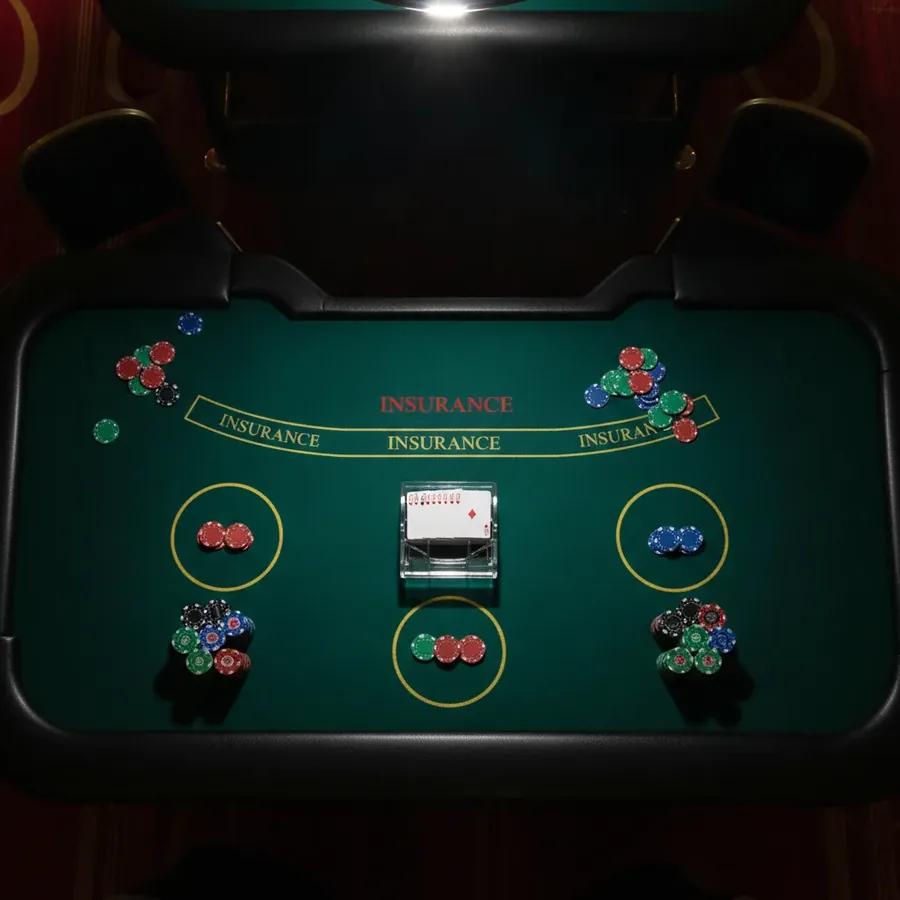
Blackjack Insurance is a separate side bet costing up to 50% of the main stake, available when the dealer shows an Ace. This wager pays 2:1 but carries a steep house edge of 7.47% with six to eight decks in play. Relying on this option significantly reduces long-term returns compared to standard base game strategy.
Even Money acts as an automatic insurance payout when holding a natural blackjack against a dealer Ace, guaranteeing a 1:1 return. While it eliminates variance, it mathematically equates to taking insurance on every winning hand, which increases the house advantage. Players seeking optimal RTP should reject this offer unless counting cards with a true count of plus three or higher.
The standard blackjack payout remains at 3:2 for a natural hand, yielding 150 EUR on a 100 EUR bet. In contrast, accepting even money locks in only 100 EUR profit, effectively sacrificing potential upside for certainty. This decision impacts the overall expected value, as the 2:1 insurance rate rarely compensates for the increased house edge over thousands of hands.
What Hole Card Means at a Live Table
Live tables utilize continuous shuffling machines or specific dealing protocols that eliminate the traditional hole card concept entirely. Dealers reveal all player cards immediately, ensuring transparent gameplay without waiting for the dealer's hidden second card. This structural difference accelerates round duration and removes strategic ambiguity regarding the dealer's potential blackjack.
Evolution’s Lightning Blackjack features unlimited players and lightning multipliers up to 25x on winning hands, operating under live stream rules. The absence of a hole card means outcomes are determined instantly after the initial deal phase concludes. Players observe real-time card distribution rather than anticipating a hidden value that could alter the final result.
Quantum Blackjack Plus by Playtech offers stakes from 1 to 5,000 EUR with quantum multipliers reaching 1,000x on three-card combinations totaling twenty-one points. The live format ensures immediate resolution of all bets without the suspense of revealing a hole card. This transparency aligns with the high volatility nature of the game, where payouts depend strictly on visible card values.
Statistics display saves the last 100 rounds
The statistics interface retains data from the previous one hundred rounds to help players track recent table trends and patterns. This historical record allows users to monitor variance and adjust their betting strategies based on short-term outcomes observed during the session. Accessing this data requires no additional cost beyond the standard table entry fee.
Blackjack Party hosted by Evolution includes two moderators creating a party atmosphere while displaying these statistical summaries for each participant. The interface tracks wins, losses, and specific outcomes like blackjacks or busts within the stored one hundred round window. This feature supports informed decision-making without interfering with the live dealer's interaction speed.
Lightning Blackjack displays its own unique metrics alongside the standard history, reflecting the impact of lightning multipliers on total returns. Players can analyze how often high-value multipliers hit within the saved dataset to gauge game volatility. Understanding these frequency distributions helps manage bankroll expectations across different streaks of luck.
Insurance Pays 2:1 Yet Still Costs Money
Insurance wagers pay out at odds of 2:1 if the dealer possesses a ten-value card as the hole card. Despite this favorable payout ratio, the probability of the dealer having blackjack is less than one in three, resulting in a negative expected value for the player. Accepting this bet consistently erodes the bankroll faster than playing the main game alone.
The house edge for insurance stands at 7.47% when using six to eight decks, making it one of the worst bets in the casino. Basic strategy dictates always declining this option unless the player is counting cards with a true count of plus three or higher. Deviating from this rule significantly increases the overall casino advantage per hour of play.
Blackjack Surrender improves the base game RTP by approximately 0.08 percentage points, offering a much better risk mitigation tool than insurance. When surrendering late, players lose only half their bet after checking for dealer blackjack, preserving more capital. Comparing these mechanics reveals that insurance is structurally inferior for long-term profitability.
RNG draws cards from virtual eight-deck shoe
Random Number Generator software simulates a virtual shoe containing eight decks of cards for standard digital blackjack variants. This configuration results in a house edge of 0.46% when adhering to strict basic strategy rules like standing on soft seventeen. The eight-deck setup balances fairness with operational efficiency for high-volume online play.
Using fewer decks typically lowers the house edge, with a single deck offering a theoretical return of ninety-nine point eighty-five percent. However, many RNG games compensate for this advantage by reducing blackjack payouts from 3:2 to 6:5. This change increases the house edge dramatically to 1.85%, outweighing any benefit from reduced deck counts.
Liberal Vegas Strip rules provide a superior alternative, combining soft seventeen stands with double after split and resplitting aces. These modifications reduce the house edge to just 0.28% despite using multiple decks in the shoe. Players seeking optimal odds should prioritize tables offering these specific rule sets over standard configurations.
No Double Down on three cards
Blackjack Liberal Vegas Strip enforces a strict two-card limitation for doubling, excluding the option to double on three or more cards. This restriction increases the house edge by approximately 0.14 percentage points compared to rules allowing Double After Split (DAS). Players lose the ability to capitalize on favorable three-card totals like 9, 10, or 11 after an initial hit.
Standard deviation for this variant is recorded at 1.15, indicating moderate volatility within the game's mathematical structure. The rule set includes S17, DAS, and Resplit, but the ban on multi-card doubles reduces strategic flexibility. Consequently, the theoretical return to player stands at 99.72% with a house edge of 0.28%.
Players must adhere to basic strategy without relying on doubling opportunities for complex hands. A $10 bet yielding a natural Blackjack pays out $15 under the standard 3:2 ratio. The exclusion of three-card doubles slightly elevates the casino's advantage over pure card-counting scenarios.
Which hands are excluded from Surrender?
Late Surrender is available in the Liberal Vegas Strip variant, allowing players to forfeit half their bet after the dealer checks for blackjack. This rule improves the RTP by approximately 0.08 percentage points, reducing the house edge from 0.46% to 0.38% in isolation. The feature applies only if the dealer does not hold an Ace or Ten-value card initially.
Hands totaling 15 or 16 against a dealer 10 are prime candidates for surrender, saving 50% of the stake versus potential loss. Early surrender, which permits giving up before the dealer peek, is significantly more valuable at up to -0.6 percentage points but remains extremely rare. Mystake Casino offers the later, less advantageous version of this mechanic.
The payout upon surrender is strictly 50% of the original wager, returning half the money immediately. For a €100 bet, the player retains €50 while the casino keeps the other half. This mechanism provides a safety net for statistically weak positions without altering the core 3:2 blackjack payout structure.
Ace Split: only one card per hand
Splitting Aces is permitted up to four separate hands, but each new hand receives exactly one additional card. This restriction prevents further splitting or hitting, effectively capping the potential upside of ace pairs. The rule is standard across most 6-deck variations including the Liberal Vegas Strip configuration.
Resplitting Aces (RSA) generally improves the RTP by about 0.08 percentage points compared to non-resplit rules. However, the single-card limitation neutralizes much of this benefit by restricting subsequent strategic moves. Players cannot rebuild strong hands from multiple aces once the split occurs.
The house edge remains low at 0.28% due to liberal overall rules, but ace handling limits long-term profitability for card counters. Insurance bets pay 2:1 but carry a high house edge of 7.47%, making them mathematically unsound for basic strategists. The single-card ace rule aligns with industry standards for fair play enforcement.
Double Down after Split: which tables allow it
Double After Split (DAS) is explicitly allowed in the Blackjack Liberal Vegas Strip variant, enhancing player options post-split. This rule reduces the house edge by approximately 0.14 percentage points compared to games prohibiting double-downs on split hands. It applies to all split hands, including those formed from tens or fives.
In contrast, some variants restrict doubling to only the first two cards of any hand, eliminating DAS entirely. The absence of DAS typically increases the house edge by roughly 0.14 percentage points relative to its inclusion. Players should verify table rules before seating, as this parameter significantly impacts expected value.
Lightning Blackjack by Evolution allows unlimited players but features specific multiplier rules rather than traditional DAS discussions. Quantum Blackjack Plus by Playtech focuses on multipliers up to 1,000x for three-card combinations. These live dealer titles operate on different mechanical frameworks than the RNG-based Vegas Strip model.
How much time is left for the decision?
Live dealer tables such as Lightning Blackjack impose strict time limits for player decisions to maintain game flow. The duration varies by provider but typically ranges between 10 to 20 seconds per action. Missing the timer results in an automatic 'stand' or 'hit' based on preset default strategies.
RNG-based games like Blackjack Liberal Vegas Strip usually offer unlimited time for decision-making, allowing thorough analysis. This contrasts sharply with live studio environments where latency and real-time interaction constrain player agency. The 99.72% RTP assumes optimal play regardless of the temporal pressure applied.
Quantum Blackjack Plus introduces quantum multipliers that trigger randomly, adding a layer of unpredictability to timing. Players must react quickly to these events to maximize potential payouts up to 1,000x. The standard betting range of €1 to €5,000 accommodates both cautious and high-stakes decision timelines.
Contact
Live - online chat
Banking





Providers











Mystake Casino 2026